
Most fitment feedback we get is one line. "Fitted up fine, thanks." Useful, but it does not tell you much.
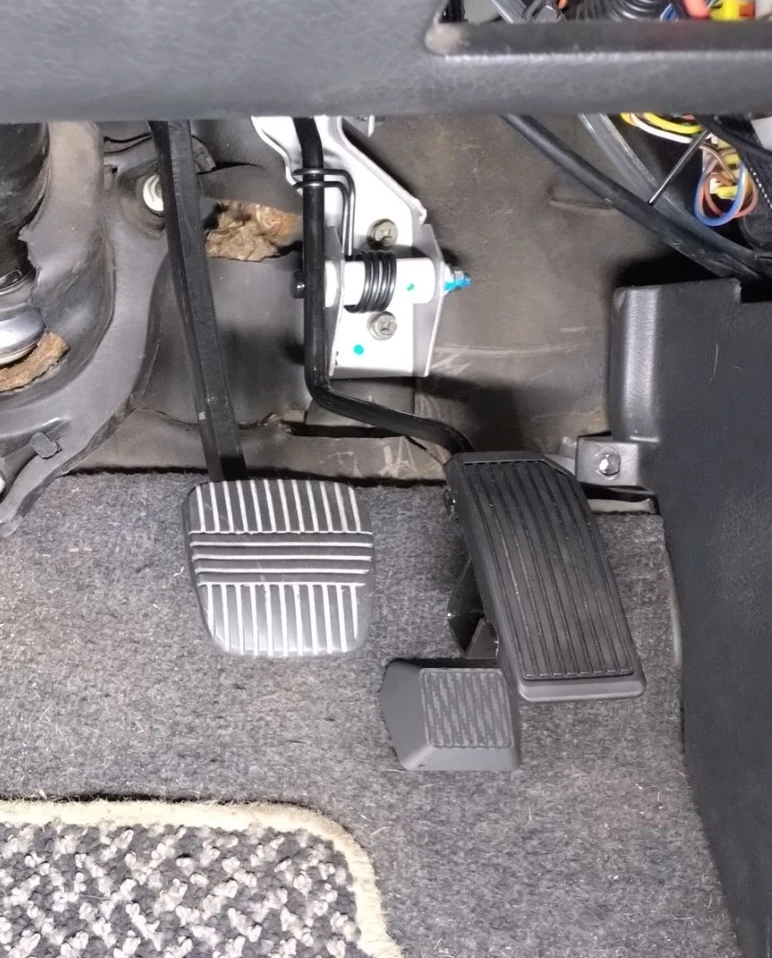
(customer didn't want his full name posted) F.G. from France, bought one of our universal electronic throttle pedals, wired it into a Haltech Elite 2500 in his 1991 Nissan Skyline R32 GTS-4, and ran it for a full summer before sitting down to give us some feedback. He has given us the rundown, the photos and permission to use his initials, so here it is, including the two things he had to change.
The install
The universal pedal mounts on a sheet metal backing plate with 40mm centre to centre bolt spacing. R32 is one of the cars where that pattern already matches the firewall, so F.G. bolted it straight to the existing holes without an adapter plate. The sensor is the Japanese AISAN 6 pin unit that ships with every kit, and the wiring plug and terminals come in the box.
What it did not do is land in exactly the right place for his foot. That is the honest trade with a universal pedal: it fits the car, but you set the final position yourself.
The two things he changed
He bent the rod. F.G. adjusted the bend of the pedal rod to bring the pad to a position he liked. It is a steel rod and it is meant to be bent, so this is a vice and a ruler job to get the pad sitting where you want it.
He replaced the stopper with a thinner 3D printed one. The pedal needs a hard stop that halts travel before the accelerator position sensor runs to the end of its rotation. The kit ships with a backstop behind the pedal pad already attached to the steel rod section of the pedal, but it usually will not be in the right place to do that job on a given car, so it has to be adapted. F.G. did it with a thinner 3D printed stopper to get the travel he wanted.
Why universal, when we make an R32 pedal
We do make an R32 pedal. It is the Nissan Skyline R32 DBW Pedal Kit ↗, built from 3D scan data of the factory pedal, with the rod 3D printed in stainless steel and welded to our universal pedal unit. It puts the pedal pad in the factory position, which means no bending and no guessing about where your foot ends up.
F.G. went the other way, and in his case it worked out well. He wanted a pedal he could tune to his own position, and bending a rod is cheaper than buying a different part. There is a place for both, so here is the short version:
- If you want to fabricate and set your own pedal position, take the universal kit.
- If you want to bolt it in and have the pad land where the factory pad was, take the R32 kit.
- If you are not sure, the universal pedal page has the dimensions to check against your own car, and a free 3D model you can print and test fit before you order anything.
The next project is already measured
F.G. also test fitted the pedal in his 1985 Mazda RX-7 FB while he had it out. Out of the box the fit was close: it would need one hole redrilled, and a small adjustment to push the pad to the correct location. He plans to order another one when that build comes back around.
For us that is the interesting part of this feedback. The FB is not a car we build a rod for. We make a rod for the RX-7 FD, but the FB is different ground, so this is the sort of detail that decides whether a part works there or not. If you are putting a drive-by-wire pedal into an FB, we would like to hear how it goes.
In his words
"I have installed the pedal in my 1991 Nissan Skyline R32 GTS-4, wired into a Haltech Elite 2500. I have been using it the whole summer. I had to adjust the bending of the rod to put the position to my liking, and replace the pedal stopper with a thinner one (3D printed) to get the right travel. Overall I'm very happy with the installation ease and final fit/feel."
"I also made a test fit on my 1985 Mazda RX-7 FB. It would require redrilling one hole, but the fitment seems pretty good out of the box, some minimal adjustment might be needed to push it to the right side a bit, or extend it downward. I will likely order a new one once I start working on this project again."
Thanks F.G. Feedback like this is what tells us where a part needs work, and a car that has run a whole summer is worth more than a fresh install photo.
If you have one of our pedals in a car and you have lived with it for a while, we want to hear about it, including the parts you had to change. Send it through with a photo or two and we will feature the useful ones here.
Our DBW Pedal Options
We have a range avialable for Nissans, More coming for toyota, mazda and many more! if we don't have it reach out.
Frequently asked questions
Common questions about our universal DBW pedal, and how it differs from the adapted R32 kit.
Yes. The pedal's 40mm centre to centre bolt spacing matches the R32 firewall, so it bolts to the existing holes. The part you set yourself is the final pedal pad position. See the universal pedal kit.
Yes, and that is the design intent. The rod can be cut, bent, welded etc to move the pad, and the backstop usually needs adapting so the pedal stops before the sensor runs out of rotation.
The universal kit is a fabrication starting point: and you set the final pedal pad position. The R32 DBW Pedal Kit uses 3D scan data and a stainless steel printed rod, so the pad lands in the factory position.
No. A backstop is fitted behind the pedal pad, but on most cars it will not sit where the sensor needs it to, so the bracket under the pad has to be adapted with a bolt or set screw, or a stopper of your own.
A new 6 pin accelerator position sensor made by AISAN in Japan, plus the wiring plug and terminals. The wiring pinout diagram is in the documents on the product page.
Orders ship in 2 to 3 business days from New Zealand